
How to Check for a Warrant in Dallas County
Start with the court side. Dallas County posts no full active-warrant list online. Iowa Courts Online lets you search trial-court cases by name, date of birth, case ID, or citation, though it carries no public warrant-status filter. The Arrest/Inmate Inquiry reports booking and custody facts only. It is not a pre-arrest register. Before searching, gather the full legal name, birth date, case or citation number, and venue. When online tools leave the question open, call the Clerk at 515-993-7018. The Jail takes custody and bond questions at 515-993-5815, and the Sheriff routes agency calls to 515-993-4771.
- Confirm the matter is in Dallas County, Iowa.
- Search the court system with the most exact identifier.
- Check the jail portal only for a booking record.
- Call the office that controls the needed record.
- Ask counsel about a court-approved response.
Dallas County Has No Full Warrant List
The Sheriff publishes a booking inquiry, daily reports, resources, and a Chapter 22 request form. A complete public export of outstanding Dallas County warrants does not exist. A blank jail search proves nothing either. The person may never have been booked, an entry may be new, or the warrant may sit unserved or restricted.
Key point: A clean public search is a lead, not official proof that a Dallas County warrant is absent or cleared.
Take docket questions to the Clerk. Bond and custody questions go to the Jail. The Sheriff handles agency routing, and a lawyer belongs beside you before any appearance where arrest is possible; the restricted state system is not a public alternative.
Types of Warrants in Dallas County
Judges and magistrates of the Iowa District Court issue Dallas County warrants. There is no separate municipal criminal court. Iowa also runs no justice-of-the-peace network. Official sources write FTA warrant or arrest warrant for failure to appear, never capias pro fine.
| Type | How It Arises | Authority |
|---|---|---|
| Arrest warrant | A complaint supports probable cause. | Judge or magistrate |
| Bench or FTA warrant | A person misses a required case step. | Judge handling the case |
| Search warrant | Probable cause supports a search. | Judicial officer |
| Fugitive warrant | Another jurisdiction seeks custody. | Issuing jurisdiction |
Civil process in Dallas County moves through a separate service system, and its fees and timing do not follow criminal warrant rules.
Dallas County Booking Search Limits
The official county inmate page routes visitors to the Arrest/Inmate Inquiry. That portal accepts a name, subject number, booking number, custody choice, booking dates, and housing facility. Results cover people recorded in the booking system. They do not cover every active warrant. The official booking interface spells out this narrow role.
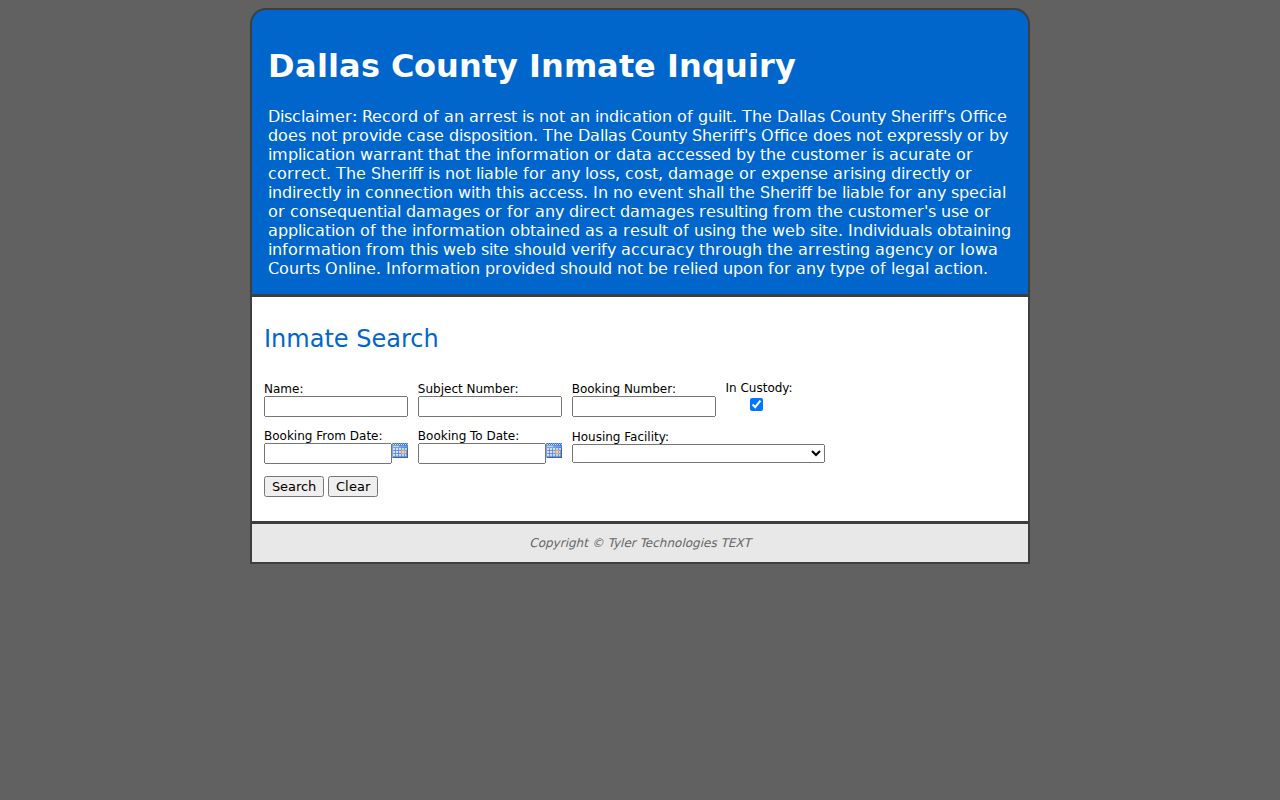
Its 100-row display pattern is not an active-warrant count.
| Field | Use | Limit |
|---|---|---|
| Name | Find a booking | Match rules are unstated |
| Booking number | Narrow a jail record | Not a warrant number |
| Dates and custody | Filter jail records | Misses unbooked warrants |
What a Dallas County Warrant Record Shows
Dockets, warrants, and booking records answer different questions. A Dallas County docket may hold a case ID, charge, events, and disposition. A warrant names the person and the alleged offense. It also lists the place and date of issue, judicial officer, bail endorsement, and return. Booking records add custody and bond facts after arrest.
| Identifier | A case ID, citation, or warrant reference such as FECR-CASE-ID; no universal local format is published. |
|---|---|
| Reason | The alleged offense, charge, or missed appearance. |
| Court | The Iowa District Court venue and officer controlling the case. |
| Bond | An amount or type if the current court record provides it. |
| Status | Issue, service, return, recall, or quash events, if public. |
Warrant events linger on dockets after service or recall. Ask the Dallas County Clerk to confirm what the file says now.
Requesting Dallas County Warrant Records
The Sheriff records form takes a detailed request. Pickup or email delivery is offered. Anonymous requests are honored, though the form itself may be public. Name the record type, date range, agency, and any known case or citation. Pickup charges and email size limits may apply. No current fee or turnaround is published. Court documents go through the Judicial Branch records process. A records request cannot recall a warrant, set bond, or force disclosure of sealed, juvenile, investigative, or restricted content.
Who Issues and Serves Dallas County Warrants
The trial court is the Iowa District Court in the Fifth Judicial District. Judges and magistrates divide the work. Judicial magistrates handle simple misdemeanors, infractions, preliminary matters, search warrants, and initial appearances within their authority, while district associate and district judges take the broader cases. Courts issue Dallas County warrants. Peace officers execute them. The Dallas County Sheriff's Office serves as the main county serving and custody agency.
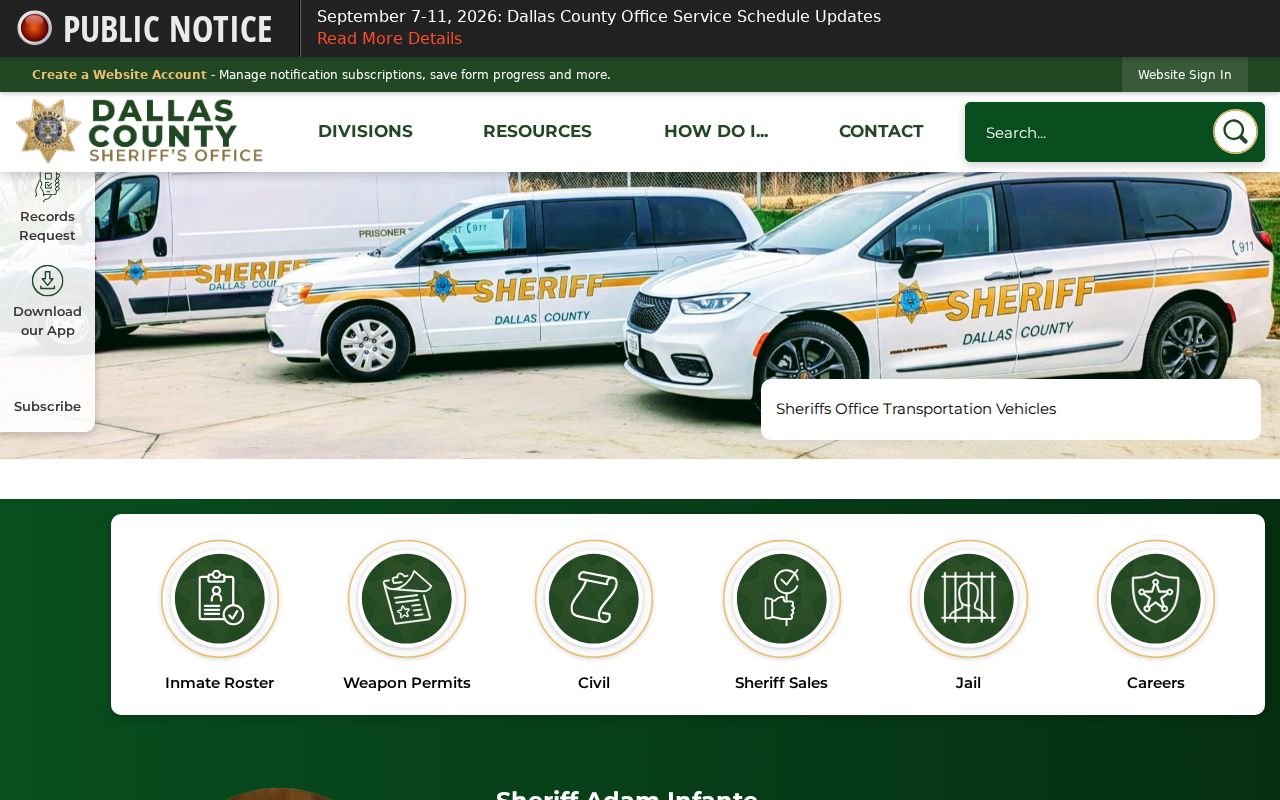
Agency routing belongs to the Sheriff. Intake and bond facts sit with the Jail, while the Clerk holds the Dallas County court-file side.
Dallas County Sheriff and Jail
28985 Thin Blue Line Lane, Adel, IA 50003
Sheriff 515-993-4771 | Jail 515-993-5815
Dallas County Courthouse Visit Route
The Clerk works from the courthouse at 801 Court Street in Adel. The nearby Administrative Building is not a warrant counter. No dedicated warrant window, surrender schedule, bond-window hours, or ID checklist is published. Call ahead. The Court Security Division screens entrants through metal detection and X-ray baggage screening, so raise any access needs with the Clerk early. The wider county site lists the full office directory.
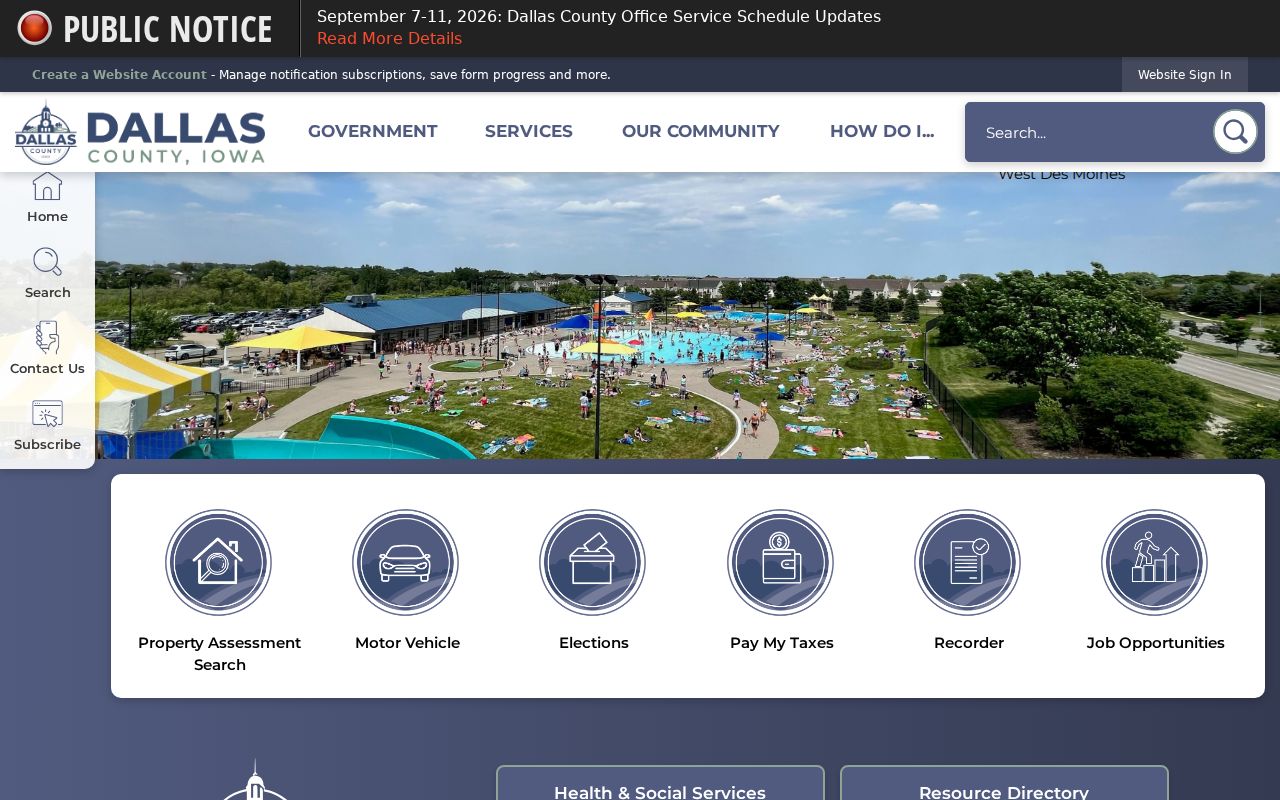
The directory points to offices, but Dallas County warrant status stays with the court, Clerk, Sheriff, or Jail.
What to Do If You Have a Dallas County Warrant
Confirm the issuing court first. The Clerk can name the case and docket event. The Jail answers custody and bond questions. Dallas County publishes no walk-in surrender method. No payment type or bond vendor is listed either. An Iowa attorney can ask the court about an appearance, recall, quash request, surrender, or bond. After arrest, Iowa law requires presentation without needless delay to an accessible magistrate. The Jail reports a new charge goes before a magistrate within 24 hours, and that magistrate determines bond. The state schedule has limited uses and guarantees no Dallas County amount. Bond addresses release and future appearance, never dismissal of the case.
Important: Ask counsel and the issuing court about the approved plan before appearing where an active Dallas County warrant may lead to arrest.
Keep your paperwork after payment, service, appearance, or an order. Ask the Clerk whether Dallas County now marks the warrant recalled, quashed, or served.
Dallas County Warrant Terms
Dallas County paperwork uses its own labels. Iowa calls a failure-to-appear warrant an FTA warrant or an arrest warrant, not the capias term you may see elsewhere.
- FTA
- Failure to appear for a required court event.
- Active
- Not shown as served, recalled, quashed, or closed.
- Served
- A peace officer executed the warrant and returned it.
- Recalled or quashed
- The court withdrew or set aside the warrant.
- Bond
- A release condition, not dismissal of the charge.
- Restricted
- Withheld from normal public view under law or rule.
Dallas County sheriff reports add tags like FTA, probation, forfeiture, fugitive, and warrant-in-county, and none of them adds up to a full roster.
Public Access to Dallas County Warrant Records
Iowa Code Chapter 22 opens most records to the public. Warrant papers are not all public at every stage, though. Dallas County can withhold or redact unserved warrants, open investigations, sealed cases, juvenile files, and private personal data.
Key Rules:
Chapter 22 sets the open-records framework.
Chapter 804 covers arrest-warrant issue, contents, execution, bail, and return.
Chapter 805 addresses citations and FTA warrants.
Chapter 232 limits juvenile-record access.
Ask whichever Dallas County agency holds the record for the public, nonrestricted portion. A Sheriff request never substitutes for a court request.
The Restricted IOWA Warrant System
The IOWA System stands for Iowa On-line Warrants and Articles. It links authorized justice agencies to state and national data, and it has no public login, roster, or self-search. Despite the name, it is not a website a resident can browse; it exists for secure law-enforcement and criminal-justice exchange. No member of the public can use it to confirm a Dallas County warrant. So use Iowa Courts Online and the Dallas County offices instead. The court search may surface a case and docket events, the Clerk can speak to the official court file, the Jail can answer for a current booking and court-set bond, and the Sheriff can route a law-enforcement records question. Because that state layer stays closed, these public channels have to be checked together. It is also why a public search that returns nothing is not conclusive.
Iowa's 2026 Warrant Clinic Change
Dallas County runs no amnesty week, safe-surrender event, roundup, or warrant-resolution clinic. HF2787 took effect June 2, 2026 and bars the prearranged clinic model built to resolve outstanding arrest warrants without immediate arrest or custody processing. The Sheriff Text-a-Tip number is a general public-safety channel, not an amnesty line and not a promise of a no-arrest visit. Regular court proceedings at a courthouse or judicial facility sit outside the law, so an ordinary appearance, a counsel-arranged motion, bond, or an official surrender all remain open. Ask the Clerk first whether a scheduled docket, motion, or payment plan can address the case; ask the Jail about bond only after the court identifies the warrant and the release authority. Check any future event against a Dallas County or Iowa Judicial Branch source. Skip third-party event listings, and treat an old notice as possibly outdated rather than lawful and current.
Dallas County Booking Records Are Not Guilt
A booking record shows arrest and custody, nothing more. The fields can include name, custody status, physical descriptors, and multiple-booking details, yet they do not prove a Dallas County warrant is still active, and an old booking says nothing about how a current case ends. The portal does not promise each entry is complete or current, so call the record holder before drawing conclusions. The county access notice spells out that distinction and shows which custody details the county publishes.
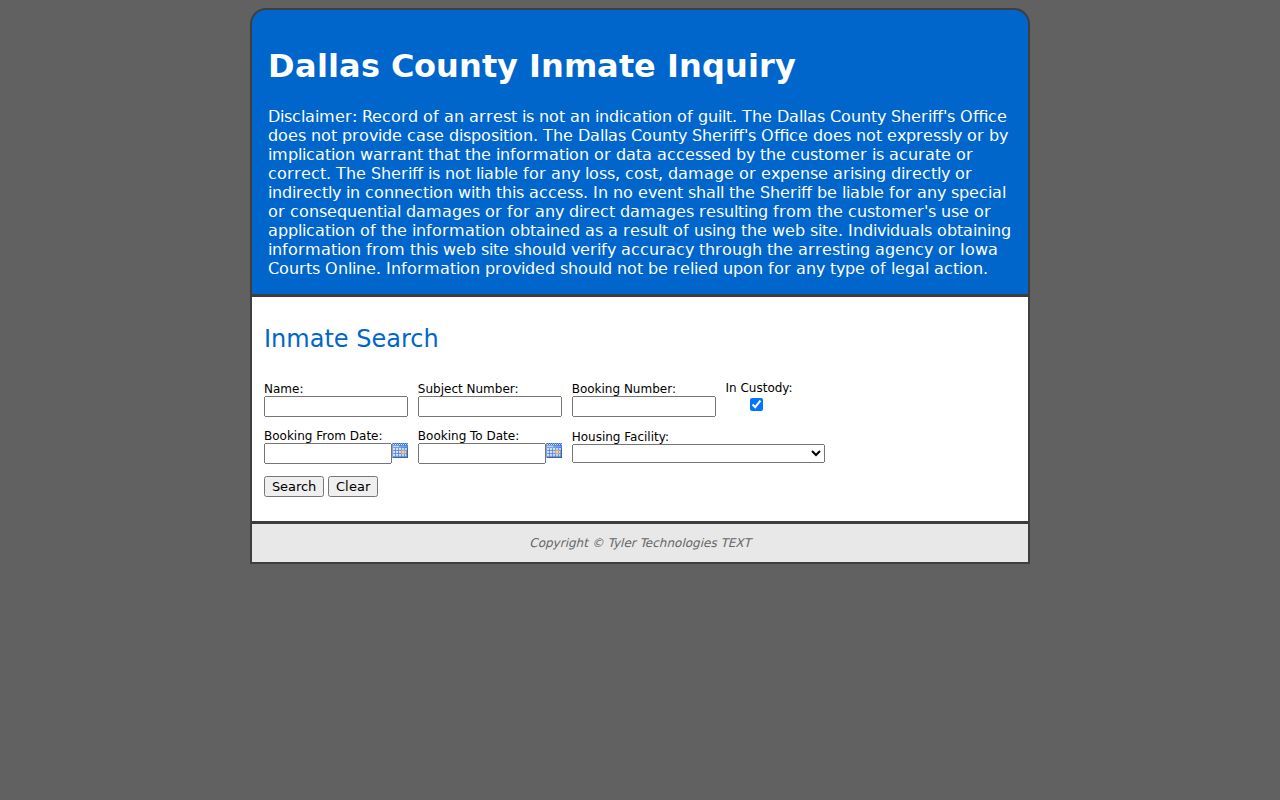
Use a booking result for one thing: a precise custody, charge, or bond question. For current custody facts, call the Jail. For later case events, including a filed return or recall, use the Iowa District Court docket and the Clerk. When Dallas County sources conflict, the record holder should explain its own entry. Note the booking number and date before calling, and keep private details to yourself rather than republishing them as a most-wanted roster.
Warrant Records by City in Dallas County
None of the five largest cities runs its own municipal criminal court. City police in Dallas County can cite, arrest, keep reports, or route a call, but the unified Iowa District Court controls the case venue and court status. Several of these cities cross county lines. When that happens, the county named on the citation decides where the record lives.
West Des Moines Warrant Records
Police records and city ticket routes.
Urbandale Warrant Records
Police records and ticket distinctions.
Waukee Warrant Records
Police record and parking payment routes.
Clive Warrant Records
Routing across Dallas and Polk Counties.
Grimes Warrant Records
Contracted Polk County Sheriff service.
Westcom handles shared dispatch for several metro cities, but it is neither the issuing court nor a warrant database. Use dispatch only for a proper non-emergency agency question. For a Dallas County warrant, the county and case number on the notice point you to the correct clerk and court record.